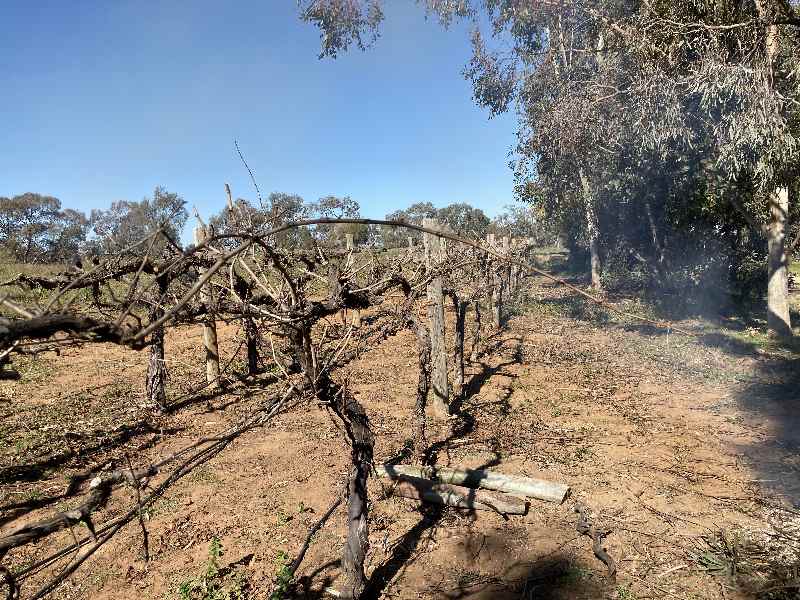
Usually, I’ve been at work when this job is done. This year, I was able to help. As well as the grapes, we had to prune back some of the trees. The vines are aging but still produce grapes. Maybe this year, we will be able to make some wine.
The last cane ready to goThe wattles needed to be well pruned backBurning some of the rubbishRows of Cabernet Sauvignon and Merlot. Add water and wait.
Two grandsons, aged 12 and 10. Six more weeks compulsory home schooling at home on the farm. Two questions. What lessons should they be learning? What lessons could they be learning? What a difference a few letters make.
The local school provides basic guidance in Literacy and Maths and provides worksheets and online exercises, but there is so much more that they learn by being at home on the farm. The oldest was up quite early, made himself breakfast and needed no help to complete all his work. It was heartening to watch the youngest sit himself at the computer, configure it so he could complete all the school requirements, personalise it so he was pleased with the appearance and get on with his work. He was organised and had his user names and passwords stored in his diary. He attacked his set work enthusiastically and had it all completed before lunch. He hopped on the treadmill and did a few kilometres also before lunch. After lunch they were free to follow their own interests. They have matured so much since Covid lockdowns began.
Hopefully, the boys will be able to learn lots of life lessons in self-sufficiency; everything from organisation, self reliance, cooking, planning, using machinery, practical maths, farming and especially gardening.
Lovely lawn
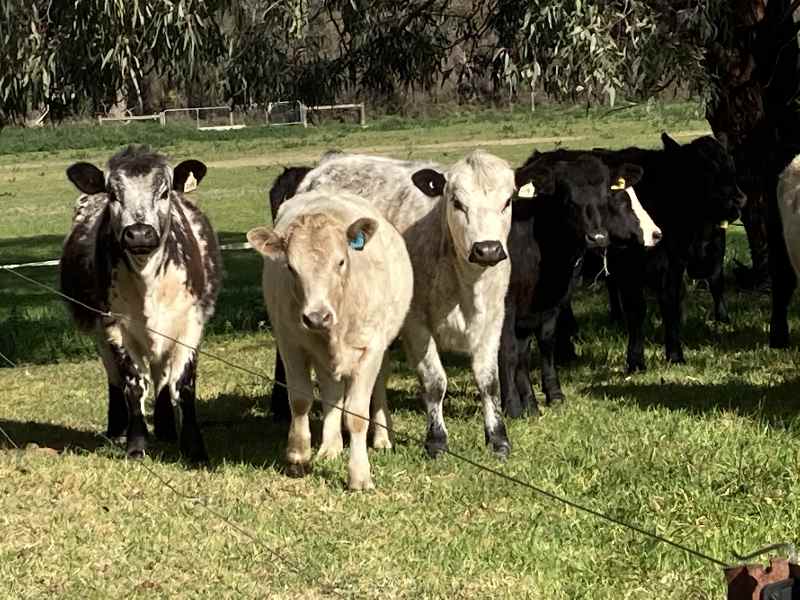
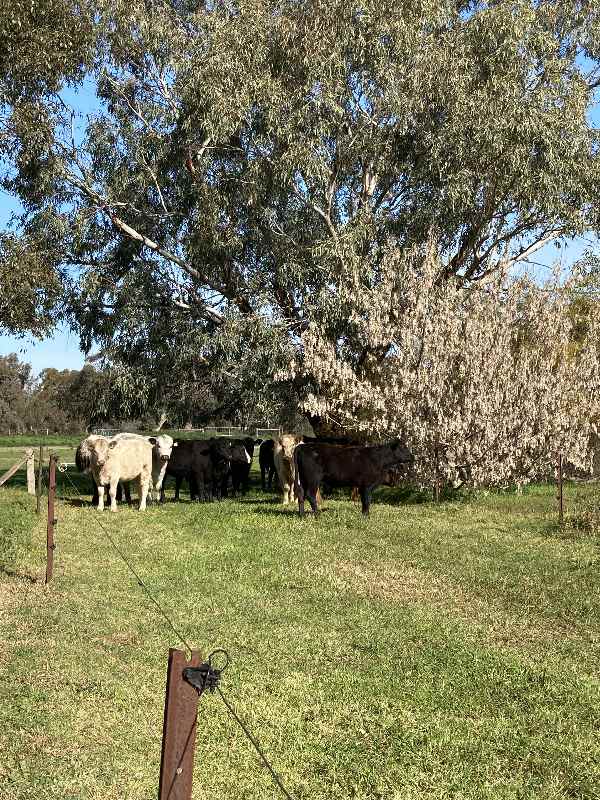
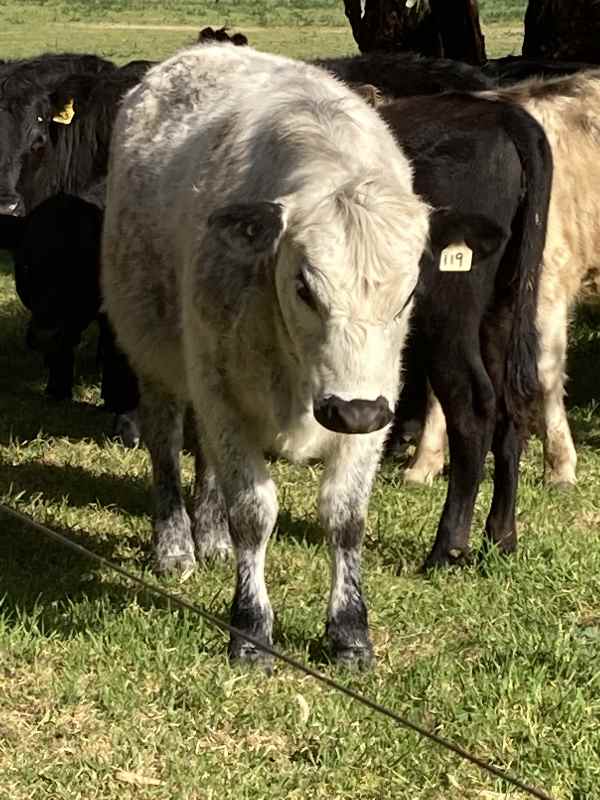
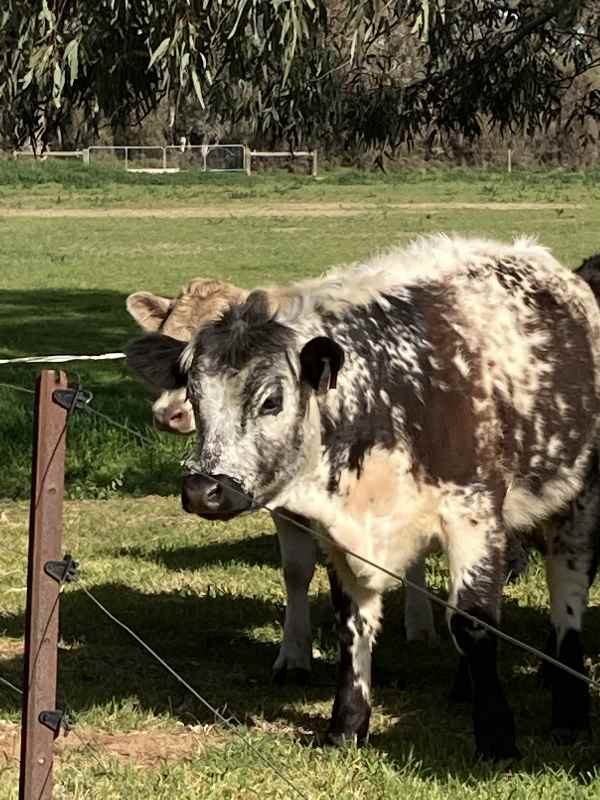
Meanwhile, I’ve got some other help. These young cattle have done an amazing job ‘mowing’ my lawn. They have the job of keeping the laneways in good shape. It certainly is much easier for me than using the mower.
30 posts into this blog, I’ve decided that I really enjoy it. I am enjoying sharing the environment where I live. It’s good to take the time to look around and appreciate where I live.
An unexpected bonus is that I also enjoy other people’s blogs. I love reading and comparing experiences. The other day, I was frustrated after looking at the rabbit damage on my farm. I stumbled on another farm blog where someone on the other side of the world was describing their problems with the rats and other animals I’ve had no experience with. I’m glad I only have rabbits and the odd wallaby!
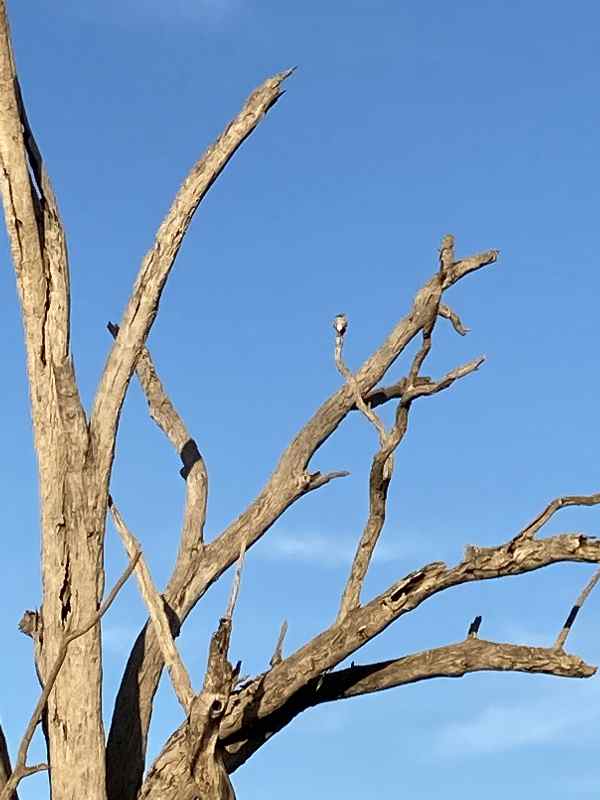
I am blown way by some of the amazing photography. There are so many bloggers who produce stunning pictures. These pictures of birds illustrate my frustration. The birds are so small, when they could be the focus of the picture. My photos have generally been taken on my phone, which does do a reasonable job at times, but I can’t help thinking that it is time to dust off my ‘real’ camera and learn how to use it properly.
This lagoon is 15 metres from my front door, separated by a gravel road. It is home to a variety of bird and wildlife. These birds know no boundary between the lagoon and my garden. These are called Crested Pigeons.
The pattern in the gum tree is called a burl. It’s a deformed tree growth. The wood is prized by some wood workers.
Crested pigeon Can you find the bird? I’m not sure what this one is..There it is!!!
In Victoria today, our premier has outlined the rules to the extreme Stage 4 lockdown, ordering thousands of businesses to close. This will be the cause of a great deal of readjustment. I’m feeling blue. What a strange expression when blue can be so beautiful. Just look at the cornflower.
Cornflowers
“The Cornflower (Centaurea cyanis), also known as bachelor’s button is a native annual/ biennial plant from Mediterranean Europe. It got the name cornflower because it grew as a weed in corn fields. Representing positive hope for the future, the Cornflower is a humble reminder of nature’s simple beauty and the fullness of life’s cycle.”
A lovely reminder at the present time. So how can blue represent sadness?
I read that the use of the color blue to mean sadness goes all the way back to the 1300s. Having read some Chaucer in my time, it was interesting to discover the claim that Geoffrey Chaucer was the first author to write the word blue. He wrote “Wyth teres blewe and with a wounded herte” in his poem Complaint of Mars from around the year 1385. Nowadays, we would write with tears of blue and a wounded heart. This could mean that from its very first appearance, blue was connected with sadness.
Cornflowers self seeded from last year
In Australia we have a wonderful organisation called Beyond Blue. Beyond Blue provides information and support to help everyone in Australia achieve their best possible mental health,
I really love it that cornflowers appear as a blue flower in the popular computer game Minecraft!! I wonder how many of the 126 million Minecraft players would recognise the flower in real life.
Did you know dandelions are symbols of emotional healing?
Here we go again. My mind is reeling as I try to gather my thoughts and prepare emotionally for the next six weeks.
My household went in to lockdown way back in March. Victorians seemed to do the right things and numbers of Covid cases decreased. But a vicious second wave sees us back in an even stricter lockdown again, as of today. It’s become part of life. I note with interest as I write, that the spell checker doesn’t recognise lockdown as a single word. I thought the time was passing quickly, so quick the spell checker hasn’t caught up.
I really shouldn’t complain. I am much better placed than many to withstand the situation. I’m far away from the city and relatively secluded. I feel for the grandkids who live with us. Homeschooling, not seeing friends and being isolated on the farm is another huge adjustment. And there’s a level of anxiety, from the situation. Still they’re resilient, even looking forward to some aspects of learning at home again. Right now it’s me who is trying to prepare for the onslaught.
This dandelion, Taraxacum officinale, caught my eye today. It must be tough to survive among the bricks. It can endure whatever is thrown at it. Some call it a weed. Others, throughout history have valued it as a herb with many special properties. You can eat it or make tea with it. It’s got lots of positive nutrients. Many, many health claims are made about a myraid of medical conditions it can help with. It is even claimed to make you look better, through skin improvement.
I love its beauty. A beautiful, circular, little ball of fluff, and it reminds me of good times with my children and grandchildren puffing the fluff away and making wishes for the future. They are actually spreading the goodness. The dandelion seed has downy fluff which serves as tiny parachutes to carry it on the breeze. Some claim it can travel a hundred miles on the wind, even over the oceans.
It can survive very tough conditions.
Another round ball of fluff is the seed of artichoke plants. Each little fluffy ball can have over 1500 seeds. They travel shorter distance and some people call the fluffy seeds, ‘fairies’ as the drift on the wind.
I fell in love with sourdough bread when I visited Pier 39, Fisherman’s Wharf, in San Francisco, many years ago. The unique tasting bread takes its flavour from the bacteria that surround the area. The bread is famous and rightly so. I’ve chased sourdough bread ever since, but nothing has been as good as my first experience of it. So I’m trying to make some myself.
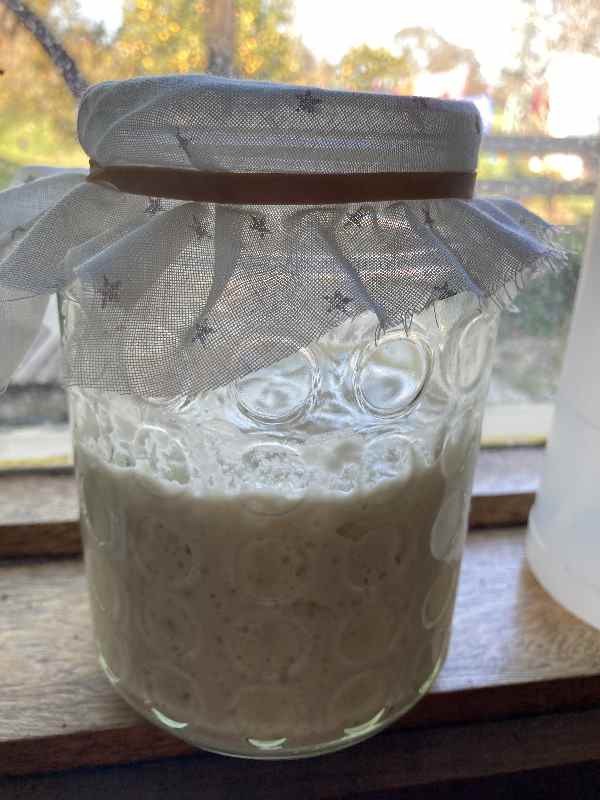
To bake it you need to have a sourdough starter mix, a culture of flour and water for growing wild yeast and developing the bacteria that give it the flavour. The starter needs looking after each day. You can purchase sourdough starter, but I’m not travelling to get it. An alternative is to buy some special yeast, but I want to experiment and see what I can make the natural way. There are lots of methods for starting this using flour and water and relying on the bacteria present wherever you are to give it it’s special flavours. This is apparently similar to making cheese and even wine, where the environment determines the flavour and characteristics. My past track record has not been successful. The last lot just went mouldy, but I’m giving it another go. I will try to tend to it every day, feeding it more flour and stirring it up.
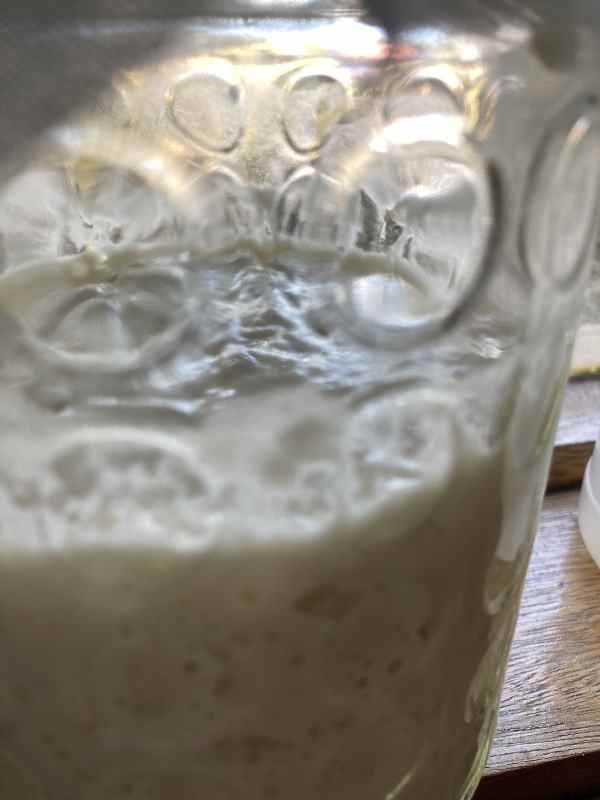
Bubbles!! that is a good sign that the yeast is developingIt’s grown in size!! also good
My starter is experimental. I bought a packet mix of sourdough rye bread. It contained the mix and the yeast. I took some of the sourdough yeast to make the starter. It was added to some plain flour, sugar, milk and water. It seems to be working. It smells like it should, sourish. Apparently you can adjust the ‘sourness’ of the starter depending on how much and when you feed the starter.
Looks OK
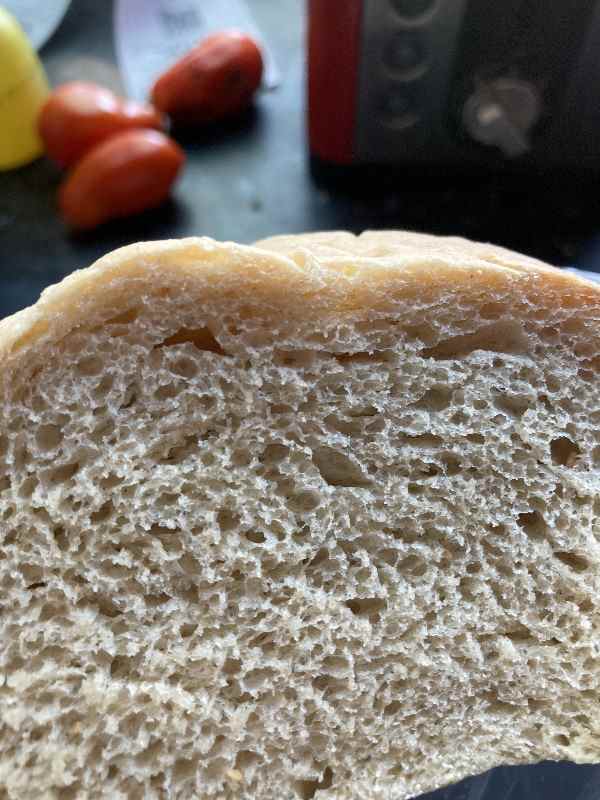
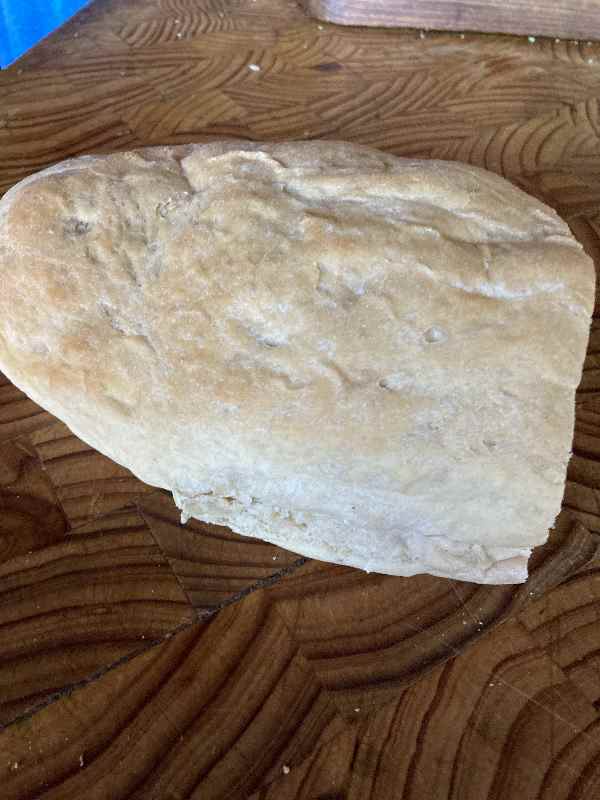
I used the rye bread with a combination of some of the sourdough yeast and some ordinary yeast to make this loaf. Apologies for the pictures. I wasn’t quick enough and there’s not much left. I made two loaves one full of my home grown olives and one plain. This is all that is left and it won’t be there after supper!
Tasted wonderful
So, to make sourdough bread you use some of the starter and add more flour and whatever else you want. You add more flour and water to the starter and off it goes again bubbling up, fermenting, ready to be used when you want the next loaf. Should be easy, right??? We’ll see.








 AT PATHO